
Solution Corner #31: The new ZDU (Recording)
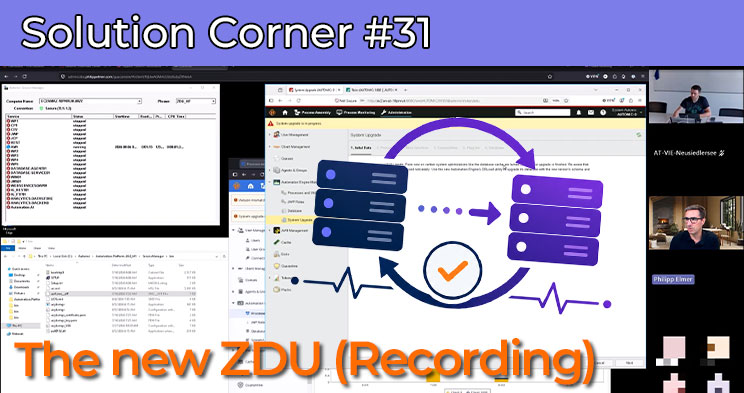
The New ZDU in Automic
The Zero Downtime Upgrade, or ZDU, is not a new feature in Automic. It has been available for many years. In recent versions, however, Broadcom has significantly improved and modernized the feature. In this webinar recording, Philipp from PEM and Andreas Ronge from Broadcom Engineering perform a live ZDU to a current Automic version and discuss the most important improvements, changes, and best practices from real-world experience.
Why the New ZDU Matters for Automic Admins
The most obvious benefit of a Zero Downtime Upgrade is that production workloads can continue running while the upgrade is performed. Jobs, workflows, users, and connections can remain active while the Automation Engine is gradually moved to the target version. In practice, however, another benefit is just as important: the traditional cold start of the Automation Engine can be avoided.
This reduces typical upgrade risks. Running processes remain more stable, inconsistent task states can be avoided, and the administrative effort after the upgrade is reduced. Especially in larger Automic environments with multiple clients, many agents, and business-critical workloads, this is a major advantage.
Live Demo: Upgrading to a Current Automic Version
The webinar demonstrates the ZDU process in a realistic demo environment. An existing Automic V24.4.5 environment is upgraded to a current V26 version. You will see how the upgrade wizard guides administrators through the individual steps, which preparations are required, and how the system behaves during the upgrade.
An important part of the process is compatibility mode. At the beginning of the ZDU, certain optimizations, such as the database schema cache, are temporarily disabled. This allows database changes to be performed while the Automation Engine is still running. The system remains available, although a small performance impact may occur during this phase.
Parallel Operation of Source and Target Versions
A key mechanism of the new ZDU is the temporary parallel operation of the source and target Automation Engine versions. Existing activities initially continue on the current version, while the processes of the target version are prepared and then activated step by step.
After the switch, new logins, new jobs, and new connections are routed to the target version processes. Existing activities can continue using their current version while they are still running. This creates a controlled transition without abruptly stopping and restarting the system.
Better Checks, More Transparency, and Safer Finalization
One of the most important improvements is the finalization phase. Instead of showing cryptic technical information about database tables, the new ZDU now displays the actual tasks that are still blocking completion. This makes analysis much easier and helps administrators make better decisions during the upgrade.
Rollback is also possible during the parallel phase. Until shortly before the upgrade is finalized, administrators can switch back to the previous version without losing the database changes that have already been applied. Only when no old activities are still running, or when they have been deliberately cleaned up, are the old processes stopped and the upgrade finalized.
Best Practices from Real Automic Environments
In addition to the technical demo, the webinar also focuses on practical experience and recommendations. Topics include preparing the target version, working with Service Manager and AWI, handling ports and firewall requirements, and choosing the right moment to finalize the upgrade. The session also explains why the wizard does not fully automate every step, but checks the process and helps prevent skipped or incorrect actions.
This recording is especially relevant for Automic administrators who want to make upgrades safer, more predictable, and less disruptive. If you want to understand how the new ZDU works technically and which improvements Broadcom has introduced in recent versions, this webinar provides a practical starting point.
On PEM Automic, you will find this webinar recording along with many other hands-on learning resources around Automic V26, administration, upgrade scenarios, and the operation of modern Automic Automation environments. Our content helps you not only discover new features, but also apply them step by step in realistic scenarios.
Learn Automic with PEM!
Would you like to learn more about Automic without having to travel across the country for workshops? At PEM, you decide when and how you want to continue your education! In interactive courses, tutorials and videos, you will learn everything you need to know about Automic – and more! And we are always there for you via comment function or email.
Does that sound interesting? Then get started today with PEM, Automic Training 2.0 and year-round Automic support!
FAQ about Automic Training on PEM
PEM is the most innovative and fastest growing Automic learning platform. It offers PEM members a comprehensive range of online training courses that can be accessed 24/7 and from anywhere. The platform includes dozens of videos and interactive courses and is aimed at beginners and professionals alike.
To meet different needs, PEM offers different types of content: courses, tutorials, learning paths, labs and tools.
- In the courses and tutorials you will learn everything about Automic in entertaining and interactive videos.
- The learning paths offer comprehensive training on a specific Automic topic. For example, the 11-part operator learning path is suitable for beginners. Are you already an Automic expert? Then you will definitely learn something with the database SQL learning path.
- Labs are automated environments that are available at the touch of a button and where what has been learned can be put into practice.
- Tools with appropriate instructions are regularly provided on PEM . This allows Automic processes to be automated and simplified even further.
In our library, you’ll find all content items currently available on PEM. And every week, we add more items to learn Automic.
PEM Labs are comprehensive, pre-configured Automic environments designed to provide users with a hands-on and immersive experience. These labs offer instant access to multiple Automic versions, allowing users to experiment with functionality and explore new features effortlessly. Available on demand and at no additional cost for members, PEM Labs eliminate the need for complex setups or extra expenses. Whether you’re a beginner or an experienced professional, they serve as realistic sandbox environments ideal for learning and experimenting with Automic.
Labs are provisioned on demand with a single click and are automatically deleted after 24 hours.
There are two different deployment-variants for the Labs:
- Labs for Operator and Designer
These provide access to a dedicated Automic Client via the Automic Web Interface (AWI). - Labs for Admins
These labs include OS-level access through a browser, enabling members to perform all administrative tasks, including those at the operating system level.
PEM Labs are available in three formats:
- Test Labs
These labs are empty Automic clients or systems that members can use for their experiments. - Course Labs
These labs include one or more scenarios where users are tasked with solving practical exercises, similar to classroom training sessions. - Story Labs
Story Labs are like Course Labs but incorporate a storyline to make the experience more engaging and entertaining. Think of them as small adventure games where you solve puzzles using Automic.
The Operator, Designer, and Admin roles in PEM align closely with the roles available within Automic itself. Each role is tailored to specific responsibilities, ensuring users focus on the skills and knowledge most relevant to their work:
- Operator:
Operators are responsible for monitoring, executing, and managing workflows in Automic. In PEM, the Operator role covers topics like workflow execution, troubleshooting, and day-to-day operations to ensure smooth automation processes. - Designer:
Designers are the architects of workflows and automation solutions in Automic. The Designer role in PEM includes content on creating, optimizing, and maintaining workflows and objects, with a focus on best practices for efficiency and scalability. - Admin:
Admins handle system-level configurations, user management, security settings, and advanced maintenance tasks in Automic. PEM’s Admin role offers in-depth training on system setup, troubleshooting, and managing complex environments, including OS-level access through PEM Labs.
By mirroring Automic’s role structure, PEM ensures that members can seamlessly apply what they learn to their actual responsibilities within the software, making the training practical and highly relevant.
We host live sessions called Solution Corners 12 times a year, offering direct interaction with our experts. These sessions are open for questions on any Automic topic, and members can submit questions in advance for a more in-depth discussion.
Additionally, we provide online consulting—exclusive video conference sessions with our Automic specialists. Members with a consulting quota can book appointments directly via the experts’ calendars, ensuring flexible and personalized support.
In normal Automic training courses, the trainer is available to you for a few days. If you’re lucky, you might be able to provide input before the training, and if you’re particularly lucky, you might be able to ask 1-2 questions in the weeks following the training.
Our members can send us an email at any time. We answer questions immediately by email. If our members have questions about specific topics, they can also use the comment function. We call this “year-round Automic support”.
You always sign up for a membership for one year. After that, it is usually renewed automatically.
You can cancel at any time up to one month before the end of the contract with a simple email. Of course, you can limit the membership to one year at the beginning of the contract.