
ADX02 - Privileged and Unprivileged Mode on the UNIX Agent
Understanding Automic UNIX Agent privileged and unprivileged Mode
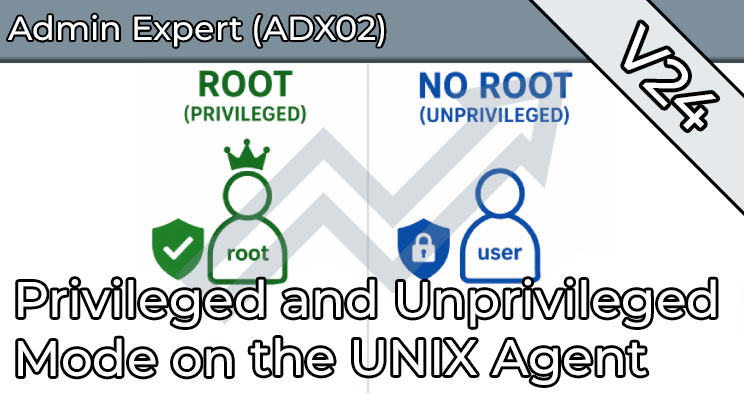
With the Automic UNIX Agent, the difference betweenprivileged and unprivileged Mode is a central security topic. It determines whether an agent can start jobs with a real user-context switch or whether all executions remain in the context of the agent user. This distinction is important when you want to operate Automic jobs on UNIX systems securely, classify login objects correctly, and implement least-privilege requirements cleanly.
In this article you will learn in a practical way how to check the runtime context of a UNIX agent and how to recognize whether a user switch actually takes place. This is not just theory, but concrete observations in the system: process list, file permissions, SUID bit, LOGIN_CHECK, login objects and job reports.
When does an Automic UNIX Agent need privileged Mode?
Theprivileged Mode is relevant when jobs on the same UNIX Agent should run under different OS users. In this mode the agent can perform a user-context switch, for example from a technical agent user to a functional batch user. That capability is powerful but must be secured deliberately.
You will learn, among other things:
- how to practically distinguish between
privilegedandunprivilegedon the Automic UNIX Agent - what role
LOGIN_CHECKplays in the agent INI - how login objects relate to the actual OS user
- why a listener process alone is not sufficient proof of security
- how to limit allowed target users via
[GLOBAL],[USERID]anduserid_type
Unprivileged Mode, Anonymous Mode and Host Characteristics
Inunprivileged Mode the Automic UNIX Agent cannot perform a user-context switch. According to the documentation, the agent must therefore be operated in Anonymous Mode. For this, LOGIN_CHECK=N in the agent configuration and the appropriate ANONYMOUS_JOB, ANONYMOUS_FT and ANONYMOUS_FE values in the associated UC_HOSTCHAR_* variable are important.
If you are looking for a clear explanation of Automic Agent security, UNIX agent user-switch, Anonymous Mode, UC_HOSTCHAR_DEFAULT, LOGIN_CHECK or least privilege, you will find clear guidance here. The article helps you choose the right operating mode for your UNIX agent and avoid common misinterpretations in Automic operations.
Learn Automic with PEM!
Would you like to learn more about Automic without having to travel across the country for workshops? At PEM, you decide when and how you want to continue your education! In interactive courses, tutorials and videos, you will learn everything you need to know about Automic – and more! And we are always there for you via comment function or email.
Does that sound interesting? Then get started today with PEM, Automic Training 2.0 and year-round Automic support!
FAQ about Automic Training on PEM
PEM is the most innovative and fastest growing Automic learning platform. It offers PEM members a comprehensive range of online training courses that can be accessed 24/7 and from anywhere. The platform includes dozens of videos and interactive courses and is aimed at beginners and professionals alike.
To meet different needs, PEM offers different types of content: courses, tutorials, learning paths, labs and tools.
- In the courses and tutorials you will learn everything about Automic in entertaining and interactive videos.
- The learning paths offer comprehensive training on a specific Automic topic. For example, the 11-part operator learning path is suitable for beginners. Are you already an Automic expert? Then you will definitely learn something with the database SQL learning path.
- Labs are automated environments that are available at the touch of a button and where what has been learned can be put into practice.
- Tools with appropriate instructions are regularly provided on PEM . This allows Automic processes to be automated and simplified even further.
In our library, you’ll find all content items currently available on PEM. And every week, we add more items to learn Automic.
PEM Labs are comprehensive, pre-configured Automic environments designed to provide users with a hands-on and immersive experience. These labs offer instant access to multiple Automic versions, allowing users to experiment with functionality and explore new features effortlessly. Available on demand and at no additional cost for members, PEM Labs eliminate the need for complex setups or extra expenses. Whether you’re a beginner or an experienced professional, they serve as realistic sandbox environments ideal for learning and experimenting with Automic.
Labs are provisioned on demand with a single click and are automatically deleted after 24 hours.
There are two different deployment-variants for the Labs:
- Labs for Operator and Designer
These provide access to a dedicated Automic Client via the Automic Web Interface (AWI). - Labs for Admins
These labs include OS-level access through a browser, enabling members to perform all administrative tasks, including those at the operating system level.
PEM Labs are available in three formats:
- Test Labs
These labs are empty Automic clients or systems that members can use for their experiments. - Course Labs
These labs include one or more scenarios where users are tasked with solving practical exercises, similar to classroom training sessions. - Story Labs
Story Labs are like Course Labs but incorporate a storyline to make the experience more engaging and entertaining. Think of them as small adventure games where you solve puzzles using Automic.
The Operator, Designer, and Admin roles in PEM align closely with the roles available within Automic itself. Each role is tailored to specific responsibilities, ensuring users focus on the skills and knowledge most relevant to their work:
- Operator:
Operators are responsible for monitoring, executing, and managing workflows in Automic. In PEM, the Operator role covers topics like workflow execution, troubleshooting, and day-to-day operations to ensure smooth automation processes. - Designer:
Designers are the architects of workflows and automation solutions in Automic. The Designer role in PEM includes content on creating, optimizing, and maintaining workflows and objects, with a focus on best practices for efficiency and scalability. - Admin:
Admins handle system-level configurations, user management, security settings, and advanced maintenance tasks in Automic. PEM’s Admin role offers in-depth training on system setup, troubleshooting, and managing complex environments, including OS-level access through PEM Labs.
By mirroring Automic’s role structure, PEM ensures that members can seamlessly apply what they learn to their actual responsibilities within the software, making the training practical and highly relevant.
We host live sessions called Solution Corners 12 times a year, offering direct interaction with our experts. These sessions are open for questions on any Automic topic, and members can submit questions in advance for a more in-depth discussion.
Additionally, we provide online consulting—exclusive video conference sessions with our Automic specialists. Members with a consulting quota can book appointments directly via the experts’ calendars, ensuring flexible and personalized support.
In normal Automic training courses, the trainer is available to you for a few days. If you’re lucky, you might be able to provide input before the training, and if you’re particularly lucky, you might be able to ask 1-2 questions in the weeks following the training.
Our members can send us an email at any time. We answer questions immediately by email. If our members have questions about specific topics, they can also use the comment function. We call this “year-round Automic support”.
You always sign up for a membership for one year. After that, it is usually renewed automatically.
You can cancel at any time up to one month before the end of the contract with a simple email. Of course, you can limit the membership to one year at the beginning of the contract.